Research
Job Market Paper
- Build at your own risk. The Welfare Effects of Climate Adaptation in Housing Markets [New draft coming soon!] [Solo-authored]
Abstract
How do housing markets respond to climate risk regulation? I study France’s Risk Prevention Plans, which combine risk disclosure with mandated adaptation. I focus on shrink swell risk, a pervasive yet low salience hazard. Using geocoded plans linked to property transactions and building permits, I find that they reduce new development and generate contrasting price responses. Existing homes experience price discounts, while homes built under the new standards command a premium, consistent with households valuing adaptation. These results suggest that regulation operates through two opposing forces: disclosure makes risk more salient, while mandated adaptation reduces households’ exposure to it. I quantify these forces using a spatial equilibrium model that separates the two channels. With full adaptation of the housing stock, the combined policy has modest effects on household welfare: net gains from mandated adaptation offset losses from disclosure, indicating that the protection benefits of adaptation outweigh its regulatory costs for households.
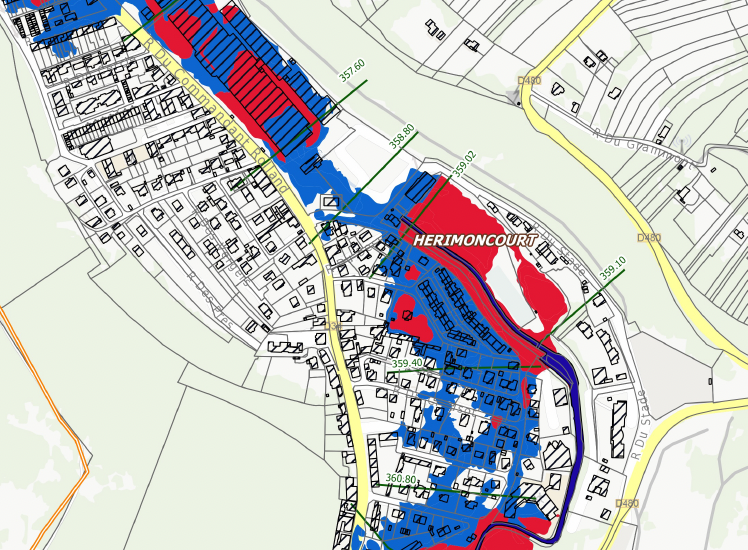
Broad audience writing (earlier versions of the project): Regards Croisés sur l’Economie
Working papers
- Mayors Strike Back: Evidence from Land Use Regulation with Guillaume Chapelle and Camille Urvoy (Submitted)
Abstract
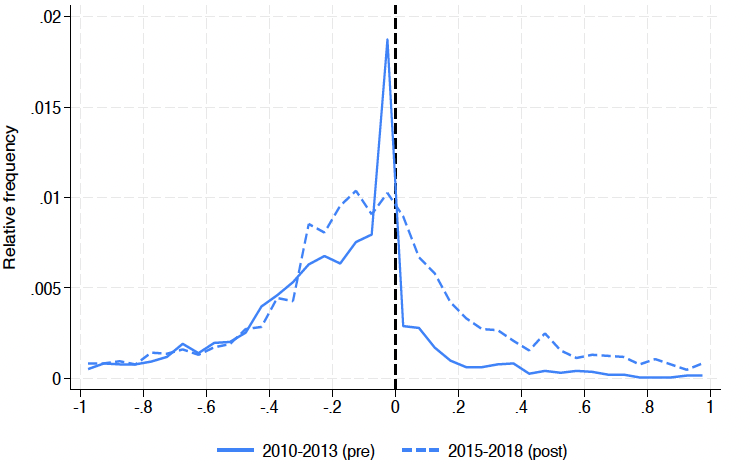
When a national government relaxes a local regulation, do local officials comply, or find other ways to keep the same rules in place? We study a 2014 French reform that abolished floor area ratios (FAR), a widely used cap on building density, with the explicit goal of expanding housing construction. We assemble a new geospatial panel tracking three zoning tools — floor area ratios, building heights, and coverage ratios — over 15 years across 118 municipalities in the Paris region, linked to building permits, housing stock, and transaction prices. Comparing municipalities where FAR existed before the reform to those where it did not, we show that local governments offset the deregulation by tightening the two instruments they retained: maximum heights fell, coverage ratios tightened, and permit denials rose. Density did not increase in previously regulated areas, and we detect no effect on prices, consistent with the limited change in supply. The regulatory tightening was strongest where mayors faced closer elections and where property values are higher, not where mayors belong to parties opposing the reforming government, pointing to electoral accountability rather than partisanship. Top-down deregulation can therefore be substantially undercut when local governments retain complementary instruments, suggesting reforms must either limit local discretion directly or realign local incentives.
Difference between observed FAR from building permits and regulatory FAR values, before and after the 2014 reform
- The Other Half of the Market. Multifamily Land and the Measurement of Urban Land Values in France [Available Upon Request] with Guillaume Chapelle, Arthur Lemoine, Alain Trannoy, and Etienne Wasmer (Submitted)
Abstract
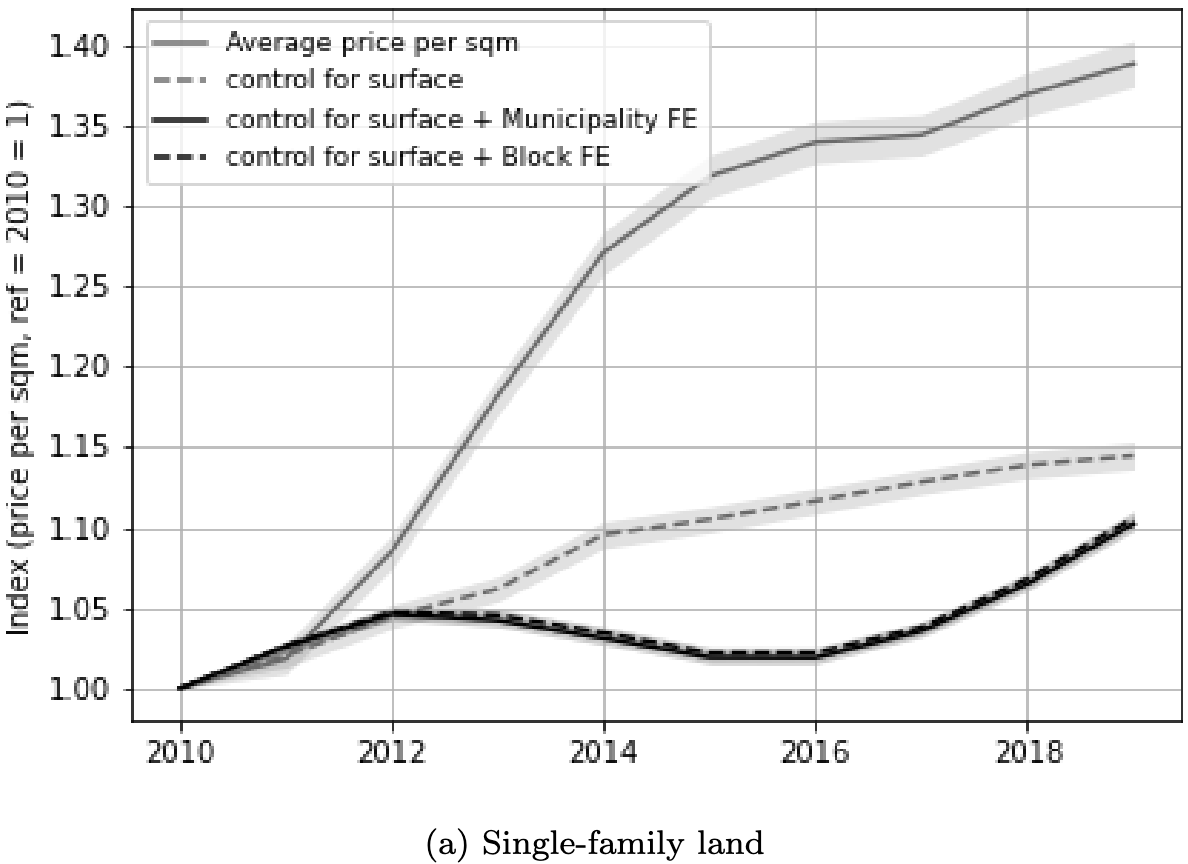
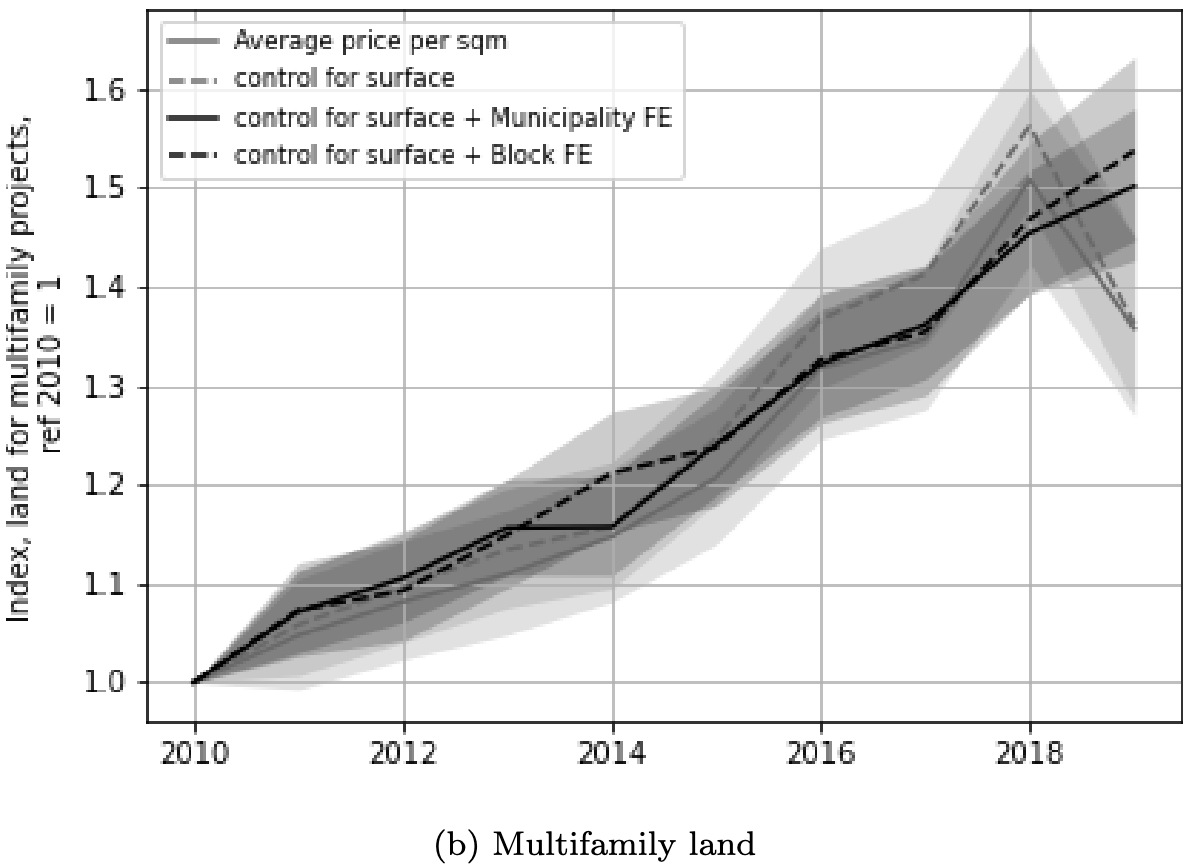
Estimates of urban land values typically rely on plots purchased for single-family houses, the only segment systematically observed in public data. This paper combines the universe of French real-estate transactions with the digitized cadaster to develop a new transaction-level methodology for identifying land acquired for residential development between 2010 and 2019, distinguishing single-family from multifamily parcels. Multifamily parcels account for only 5% of transactions but 55% of new housing units and imply central land values three to four times higher than estimates based on single-family plots alone. Over the decade, adjusted multifamily land prices rose by about 50%, compared with about 10% for single-family land.
Evolution of single-family and multi-family land prices in France, 2010-2019
Work in progress
What is France Worth? Residential Land Value Estimates with Guillaume Chapelle, Arthur Lemoine, Alain Trannoy, and Etienne Wasmer
Building in Declining Cities: Housing Depreciation, Historical Protection, and Urban Sprawl with François Lafont
A Giant with Feet of Clay: Disaster Recognition and Risk Capitalization in Housing Markets with Sacha Nass (INSEE)
Do Protective Building Codes Reduce Disaster Losses? Evidence from Natural Hazards in France with Sophie Cêtre (CCR)
Household Location, Natural Risk Exposure, and Spatial Welfare with Sophie Cêtre (CCR)